
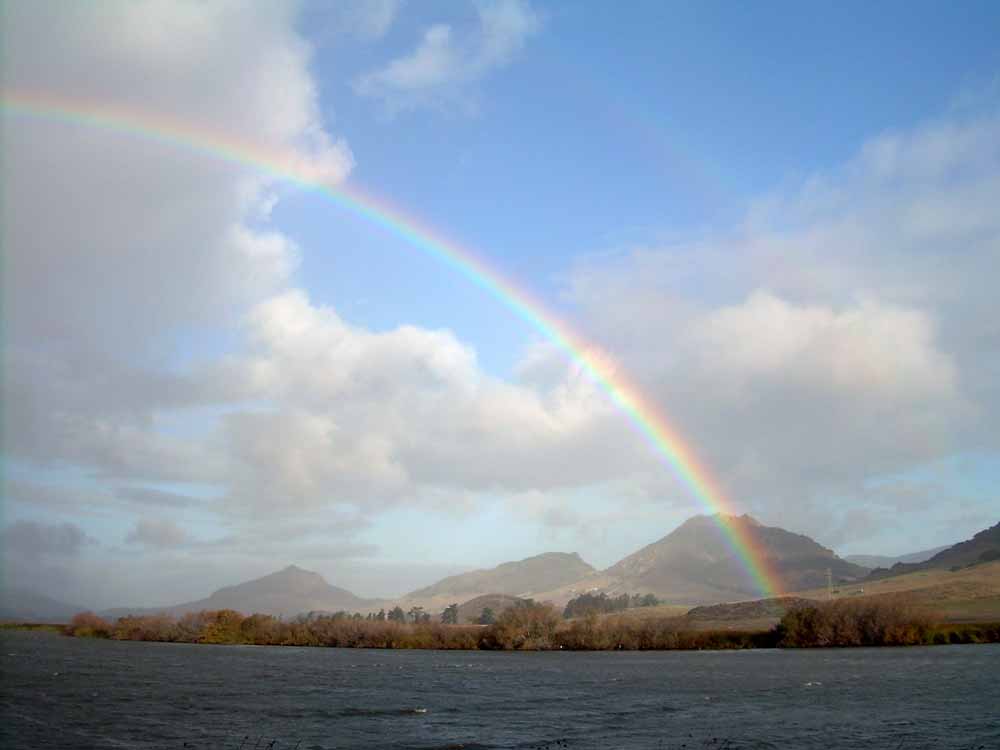
an abstract photo for sure but cool.

Their discovery fuels the work of researchers who study the development of embryos, the genesis of diseases or the workings of cells. The technique is used to disable or weaken single genes, illuminating their roles in disease and aging, and has produced more than 500 mouse models of human disorders such as hypertension and cystic fibrosis, which may aid drug studies.
``This is staggering,'' Capecchi, 70, said in an interview. He called the 3 a.m. phone call from Sweden ``a huge surprise.''
Capecchi was born in Italy, where he was forced to wander the streets for four years after his mother was imprisoned by the Nazis in a concentration camp. His mother found him after World War II and brought him to live with his aunt and uncle in the U.S. He completed his thesis work under James D. Watson, who won the Nobel Prize in Medicine along with Francis Crick in 1962 for their work on the structure of DNA.
Now a human geneticist at the University of Utah in Salt Lake City, Capecchi and Smithies, 82, of the University of North Carolina at Chapel Hill, showed how a mouse's genetic information can be permanently changed, creating animals that pass down their disease traits to their offspring.
Early in 1963 The Drifters (produced by Leiber-Stoller since 1959) recorded a Mann/Weil composition called "Only In America." When Atlantic decided not to release it the vocals were erased and replaced by Jay and the Americans. "Only In America" was released in July, 1963 and became their first chart hit (#25) with Jay Black singing lead. Leiber and Stoller's work with the Drifters and the Coasters caused them to turn over production of the group's material over to Artie Ripp of Kama Sutra Productions (Later to be Kama Sutra Records). One year and two singles later they had their biggest hit with "Come a Little Bit Closer" (#3). "Let's Lock the Door (#11) and "Think of the Good Times" both charted in the summer of 1965. At this time they began the second phase of their career with "Cara Mia" (#4). Beginning with Cara Mia" the group began covering successful oldies. Their next release was "Some Enchanted Evening" (#13) followed by Neil Diamond's first songwriting success "Sunday and Me" (#18).
Even the imprisonment of lobbyist Jack Abramoff and former Rep. Duke Cunningham, R-Calif., on corruption charges that included earmark abuses has not dulled lawmakers' appetite for pet projects. One recent study found that earmarks in House legislation went from 3,000 in 1996 to 15,000 in 2005.
And Obey said earlier this year that House members had requested 32,000 earmarks in spending bills for fiscal 2007.
"Error at the bell last night (clarification): This error at the bell last night really did contribute to the rally. Bottom line is that one of our competitors inadvertently sold 5346 too many of the SPX Sep 1450 calls and needed to cover them in a hurry. At the time the mkt was down 1% on the day.
In covering, it is likely the crowd front ran the order, exaggerating the move.
Once the move got going, the variance hedging phenomenon kicked in. Most dealers place MOC (Mark on Close) orders to hedge their daily delta risk.
If this theory holds, then they would have put in large sell orders yesterday MOC at around 3:40PM. Once the mkt started to run, their delta position would've changed from net long to net short and they would have needed to buy that much more SPX exposure into the bell. Our index trading desk predicts that for every 2 pt move up in the SPU, dealers needed to buy approx 500MM notional in delta.
With liquidity being lousy right now, that created the violent move."
this explanation came from one of the Big 5 brokers
Steve Forbes, editor-in-chief of Forbes magazine, predicts that skyrocketing oil prices are just temporary - and a massive price collapse will dwarf the Dot-Com crash that began in 2000. In Sydney, Australia this week for a global conference of CEOs, the respected financial editor said that the price of oil has inflated into an unsustainable and speculative market bubble - and he says that when this bursts, it will make the Dot-Com crash "look like a picnic."
The paper quotes Forbes as saying that the price of oil (which rose above $70 this week) had been inflated by speculators and would soon begin a rapid slide. "While there is a lot of talk in my country, the U.S., about the housing bubble, I think the real bubble, to be blunt, is in the price of oil," he said. "It's a huge bubble. I don't know what's going to pop it, but eventually it will pop. The price has to be brought down to earth, and when it does there's going to be a lot of yelping from the hedge fund managers."
Forbes said that speculation on oil hitting $100 a barrel was misplaced. He also believes that the price of oil will decline significantly in 2006.
"I'll make a bold prediction: I think in 12 months, you're going to see oil down to $35, $40 a barrel," Forbes said. "In the meantime, it's a huge drain, more a psychological drain (on the economy), but it's not forever. This thing is not going to last." Forbes blames the oil price spike on rising inflation and aggressive buying on the part of burgeoning Pacific Rim countries. "China and India are buying more of the stuff. As the global economy expands, more energy will be consumed," he said. "But if you look at the price of oil three years ago, it was $20 or $25 a barrel. Supply and demand might have shot it up to $30, $35 a barrel. The rest of it is inflation."
Forbes spoke to The Australian just as news was drifting in regarding the damage sustained to the oil-rich Gulf of Mexico in the wake of Hurricane Katrina. Industry observers say that energy companies such as BP, Chevron and Shell have been forced to shut down offshore platforms, which account for 25% of U.S. domestic oil and gas output.
here's a link to another Steve Forbes interview click here
"Delivering a speech to the National Bureau of Economic Research, the Fed chief said "changes in energy [and food] prices should have relatively little influence on 'core' inflation, that is, inflation excluding the prices of food and energy."
now that's brilliant isn't it?
Wired Magazine interviewed Nicholas Taleb (Fooled by Randomness) after publication of his latest book on risk called The Black Swan. Taleb is one of my gurus, I recommend both of his books . . . here's some of the interview
Wired: If Black Swans are the crucial determining events in history, why do we think we can predict anything at all?
Taleb: After they happen, in retrospect, we think that Black Swans were predictable. We think that if we can explain why something happened in the past, we can explain what will happen in the future.
But with better models and more computational power, won't we get better at predicting Black Swans?
We know from chaos theory that even if you had a perfect model of the world, you'd need infinite precision in order to predict future events. With sociopolitical or economic phenomena, we don't have anything like that. And things are getting worse, not better, because the growing complexity of the world dwarfs any improvement in sophistication or computational power.
So what do we do? If we can't forecast the really important things, how do we act?
You need to ask, "If the Black Swan hits me, will it help me or hurt me?" You cannot figure out the probability of a Black Swan hitting. But if you're in a business that's prone to negative Black Swans, like catastrophe insurance, I advise you not to take your forecasting seriously — and to think about getting into a different business. You don't want to be a sucker. What you want are situations where you can have as much of the good uncertainty as possible, where nothing too bad can happen to you, and where you have what I call free options. All of technology, really, is about maximizing free options. It's like venture capital: Most of the money you make is from things you weren't looking for. But you find them only if you search.
Is one of the strengths of the American system that, relatively speaking, it's more comfortable with uncertainty?
Yes. People here aren't afraid of failure. They're willing to trade the possibility of failure for the chance at a big upside. No other country is willing to do this. What America does best is produce the ability to accept failure.
"He came up and introduced himself and said he loved the song and wanted to record it," said Sommers. "We said, 'Yeah, sure.' That was the first conversation I had with him.
Whenever I asked Iraqis what kind of government they had wanted to replace Saddam’s regime, I got the same answer: they had never given it any thought. They just assumed that the Americans would bring the right people, and the country would blossom with freedom, prosperity, consumer goods, travel opportunities. In this, they mirrored the wishful thinking of American officials and neoconservative intellectuals who failed to plan for trouble . . . . . . . Although Iraqi employees had been vetted with background checks and took regular lie-detector tests, a permanent shadow of suspicion lay over them because they lived outside the Green Zone. Firas once attended a briefing at which the regional security officer told newly arrived Americans that no Iraqi could be trusted. The reminders were constant. Iraqi staff members were not allowed into the gym or the food court near the Embassy. Banned from the military PX, they had to ask an American supervisor to buy them a pair of sunglasses or underwear. These petty humiliations were compounded by security officers who easily crossed the line between vigilance and bullying.
a warning of sorts . . . this is a long article but worth the read
click here to read the rest of the article
Big time.
Back at the peak of the real estate market, when real estate agents and Wall Street shills were claiming the good times would just keep going, the Tolls took one look at the future ... and started shoveling shares out the door as fast as they could swing a spade.
In total, they sold nearly $470 million worth of stock in their company between November 2004 and September 2005, filings with the Securities and Exchange Commission show.
Nice timing -- for them."
When it comes to information about the economy, the markets or specific investment advice, it is always critically important to consider the source. Specifically, you need to know if the source of the information you are receiving is independent, or if the information is biased in some way in an effort to steer you toward their particular products and/or services. Likewise, you need to determine if the information or advice is credible.
Several of my friends have persuaded me to write this final column, which is something they claim I shouldn't leave without doing.
There comes a time when you start adding up all the pluses and minuses of your life. In my case I'd like to add up all the great tennis games I played and all of the great players I overcame with my now famous "lob." I will always believe that my tennis game was one of the greatest of all time. Even Kay Graham, who couldn't stand being on the other side of the net from me, in the end forgave me.
I can't cover all the subjects I want to in one final column, but I would just like to say what a great pleasure it has been knowing all of you and being a part of your lives. Each of you has, in your own way, contributed to my life.
Now, to get down to the business at hand, I have had many choices concerning how I wanted to go. Most of them are very civilized, particularly hospice care. A hospice makes it very easy for you when you decide to go.
What's interesting is that everybody has his or her own opinion as to how you should go out. All my loved ones became very upset because they thought I should brave it out -- which meant more dialysis.
But here is the most important thing: This has been my decision. And it's a healthy one.
The person who was the most supportive at the end was my doctor, Mike Newman. Members of my family, while they didn't want me to go, were supportive, too.
But I'm putting it down on paper, so there should be no question the decision was mine.
I chose to spend my final days in a hospice because it sounded like the most painless way to go, and you don't have to take a lot of stuff with you.
For some reason my mind keeps turning to food. I know I have not eaten all the eclairs I always wanted. In recent months, I have found it hard to go past the Cheesecake Factory without at least having one profiterole and a banana split.
I know it's a rather silly thing at this stage of the game to spend so much time on food. But then again, as life went on and there were fewer and fewer things I could eat, I am now punishing myself for having passed up so many good things earlier in the trip.
I think of a song lyric, "What's it all about, Alfie?" I don't know how well I've done while I was here, but I'd like to think some of my printed works will persevere -- at least for three years.
I know it's very egocentric to believe that someone is put on Earth for a reason. In my case, I like to think I was. And after this column appears in the paper following my passing, I would like to think it will either wind up on a cereal box top or be repeated every Thanksgiving Day.
So, "What's it all about, Alfie?" is my way of saying goodbye.


 Posts
All Comments
Posts
All Comments


